Top API-First Website Hosting 2026: 8 Platforms Compared
On this page
- What is API-first website hosting?
- Which platforms are the top API-first website hosting options?
- How does API-first hosting differ from traditional control-panel hosting?
- How do pricing and rate limits compare across API-driven hosts?
- Do these providers offer SDKs, CLIs, Terraform providers, and webhooks, or just raw REST endpoints?
- Which API-first host is best for startups, agencies, or SaaS platforms?
- Can you automate site creation, SSL, and custom domains entirely through an API?
- What should you check in API documentation and authentication before committing?
- Should you choose a developer platform or a traditional host with a bolt-on API?
- How did we compare these options?
- How do you get started with ShipSite?
- What do people also ask?
ShipSite is our top pick for API-first website hosting in 2026: a single POST to /v1/sites turns a JSON payload of files into a live URL on 300+ edge locations, billed at $3 per site per month and prorated daily. ShipSite is static hosting only; it does not run servers, databases, or build pipelines. If you need application compute or VPS control, Vercel, Render, Fly.io, Cloudways, and Vultr cover those jobs. This guide to the top API-first website hosting 2026 options compares all eight platforms on one question: can the whole site lifecycle run without a dashboard?
Key takeaways
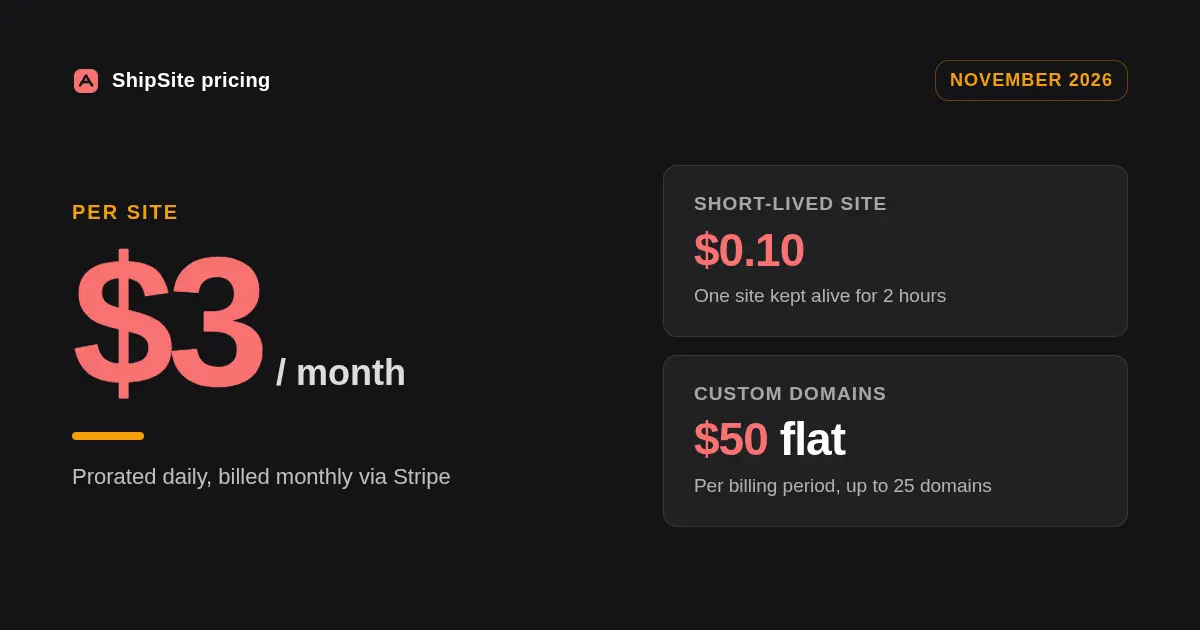
- ShipSite pricing: As of November 2026, ShipSite charges $3 per site per month, prorated daily and billed monthly via Stripe, so 10 sites cost $30 a month and one site kept alive for 2 hours costs $0.10.
- Definition: API-first website hosting means creating, deploying, securing, and deleting a site through documented endpoints, with any dashboard treated as optional.
- Competitor pricing: Vercel Pro is $20 per user per month and Netlify Pro is $19 per member per month as of November 2026; both scale with team size rather than site count, so confirm current pricing on each vendor's site.
- Rate limits: Cloudflare documents an API limit of 1,200 requests per five minutes per user, and Netlify documents 500 requests per minute, as of November 2026.
- Decision rule: Send plain files produced by a person or an AI agent to a static API host; send server code to Vercel, Render, or Fly.io; send anything that needs root access to Vultr or Cloudways.

What is API-first website hosting?
API-first website hosting is hosting where every lifecycle action, from creating a site and uploading files to attaching a domain and deleting it, is exposed through documented HTTP endpoints or a CLI, with the dashboard as an optional extra. The test is simple: can a script or AI agent finish the whole job without a human clicking anything?
The phrase gets stretched by marketing. A VPS provider with a REST API for creating servers is API-driven infrastructure, but you still install a web server, configure TLS, and copy files yourself. A platform that only accepts deploys through a git push is automation-friendly but not API-first, because the entry point is a repository, not a request.
The eight platforms in this guide all clear a minimum bar: a documented HTTP API that can create and remove the hosted thing. They differ sharply in how many steps sit between that first call and a working HTTPS URL. That step count is the metric we weight most heavily, because every extra step is a place where an automated workflow or an agent can stall.
Which platforms are the top API-first website hosting options?
ShipSite ranks first for API-first website hosting because one POST request creates a live static site for $3 per site per month, with no build step, git, or dashboard required. Vercel, Netlify, Cloudflare Pages, Render, Fly.io, Cloudways, and Vultr follow, each winning a specific job: framework apps, build pipelines, edge compute, full-stack services, VMs, managed servers, and raw infrastructure.
ShipSite: best when an AI agent or script needs a live static URL from one request. ShipSite static hosting for LLM agents accepts files as JSON at POST /v1/sites (text files as strings, binary files with a base64: prefix) and returns a URL that is live on 300+ edge locations before the response lands. Pricing as of November 2026 is $3 per site per month, prorated daily, with custom domains available as a flat $50 per billing period covering up to 25 domains. Honest limit: ShipSite hosts static files only, has no free tier, and sites auto-expire after 24 hours unless you pin them.
Vercel: best when you deploy a Next.js or other framework app and want deploys, domains, and environment variables behind a REST API. The Vercel REST API covers projects, deployments, domains, DNS records, and environment variables, and Vercel publishes an official Terraform provider. Pro is $20 per user per month as of November 2026, per Vercel's pricing page; confirm current figures there. Honest limit: per-seat pricing means a three-person team pays $60 a month before any usage, and several API capabilities are gated by plan.
Netlify: best when you want build pipelines, deploy previews, and outbound deploy notifications on a static or Jamstack site. Netlify's API creates sites and deploys them by uploading a zip or a file digest, and the Netlify API getting-started guide documents a limit of 500 requests per minute as of November 2026. Pro is $19 per member per month per Netlify's pricing page. Honest limit: build minutes and bandwidth are metered, and the file-digest deploy flow takes multiple round trips rather than one request.
Cloudflare Pages and Workers: best when you want edge compute, key-value storage, and DNS under one API and one account. Cloudflare's API spans DNS, Pages projects, Workers scripts, and certificates, with a documented limit of 1,200 requests per five minutes in the Cloudflare API limits reference. The Pages free tier includes 500 builds per month per Cloudflare's Pages limits page, and Workers Paid is $5 per month as of November 2026 per Cloudflare's Workers pricing page. Honest limit: the API surface is enormous, and the direct-upload path for Pages is designed around the Wrangler CLI rather than a single public request.
Render: best when you want static sites and backend services on the same platform with a public API and infrastructure-as-code Blueprints. The Render REST API covers services, deploys, environment variables, custom domains, and Postgres, and Render publishes an official Terraform provider. Static sites run on the free tier as of November 2026. Honest limit: Render offers fewer regions than the hyperscalers, and a handful of settings still live only in the dashboard.
Fly.io: best when you need full VMs close to users and want to drive them programmatically. The Fly Machines API creates, starts, stops, and destroys micro-VMs across dozens of regions, billed on usage. Honest limit: there is no static-site product; you run a web server inside a VM, so TLS termination, scaling, and health checks are your responsibility.
Cloudways: best when you need managed WordPress or PHP servers on DigitalOcean, Vultr, AWS, or Google Cloud through one API. The Cloudways API launches servers, adds applications, clones, and manages backups, with hourly usage settled on a monthly invoice. Honest limit: the unit of work is a server, not a site, and the Cloudways console remains the primary interface, with the API as an add-on for automation.
Vultr: best when you want raw infrastructure (instances, block storage, DNS, load balancers) with an API, CLI, and Terraform provider. The Vultr API v2 covers compute, Kubernetes, object storage, and DNS, billed hourly. Honest limit: Vultr gives you a server, not a site; the web stack, deploy process, and certificates are all yours to build and maintain.
| Option | Best for | Pricing or format | Standout limit |
|---|---|---|---|
| ShipSite | Agents and scripts deploying static sites from one request | $3 per site per month, prorated daily; custom domains $50 flat per billing period | Static only, no free tier, 24-hour expiry unless pinned |
| Vercel | Next.js and framework apps with full REST API | Pro $20 per user per month plus usage | Per-seat cost grows with team, not sites |
| Netlify | Static sites with build pipelines and previews | Pro $19 per member per month plus usage | Multi-step digest deploy, metered build minutes |
| Cloudflare Pages/Workers | Edge compute, DNS, and storage under one account | Pages free with 500 builds per month; Workers Paid $5 per month | Huge API surface, CLI-centric direct upload |
| Render | Static plus backend services with one API | Static sites free; services billed per instance | Fewer regions than hyperscalers |
| Fly.io | Full VMs driven by the Machines API | Usage-based | No static product; you run the web server |
| Cloudways | Managed WordPress and PHP servers via API | Hourly usage billed monthly | Server is the unit, console is primary |
| Vultr | Raw IaaS with API, CLI, and Terraform | Hourly usage billed monthly | You build the entire web stack |
Pricing above is as of November 2026; confirm current figures on each vendor's site before committing.
How does API-first hosting differ from traditional control-panel hosting?
Traditional control-panel hosting treats cPanel or a web dashboard as the source of truth and bolts an API on later, so some actions stay manual. API-first hosting inverts that order: the endpoint is the product, the dashboard is optional, and every action a human can take is also available to a script, an agent, or a CI job.
The difference shows up in three places. First, account creation and billing: on a control-panel host you register and add a payment method in a browser before an API key exists. ShipSite reverses that, since POST /v1/accounts creates the account and returns the API key plus a Stripe checkout link in one response, and the human's only job is clicking that link.
Second, error design. An API-first host writes errors for machines, which is why every ShipSite error states what went wrong, why, and how to fix it, so an agent can self-correct without a human reading logs. Third, deletion and teardown: if removing a site requires a support ticket or a dashboard click, the API is not first, whatever the marketing says.
How do pricing and rate limits compare across API-driven hosts?
Pricing across API-driven hosts splits into three models as of November 2026: per-site usage billing (ShipSite, $3 per site per month), per-seat subscriptions (Vercel Pro and Netlify Pro, both priced per user or member rather than per site), and hourly resource billing (Vultr, Cloudways, Fly.io).
Here is a worked example for an agency running 10 client microsites with a three-person team, as of November 2026. On ShipSite, 10 sites cost $30 a month; adding the Custom Domains plan is a flat $50 per billing period on top of that and covers up to 25 hostnames across the account. On Vercel Pro, three seats cost $60 before any bandwidth or function usage, and on Netlify Pro three members cost $57, based on the per-seat prices published on each vendor's pricing page. The per-seat platforms get cheaper per site as you add sites; ShipSite gets cheaper as you shrink the team.
Short-lived sites change the math again. ShipSite's daily proration means a preview that lives 2 hours costs $0.10, and sites left unpinned auto-expire after 24 hours so forgotten previews stop billing on their own. On per-seat platforms the preview itself is free, but the seat is not.
Rate limits matter more for agents than for humans because an agent can fire requests faster than anyone clicks. ShipSite's deploy flow is one request per site, so a 10-site rollout is 10 requests, which keeps documented limits out of the picture for most agencies. Platforms whose deploy flow needs a digest upload, a file-by-file upload, and a status poll multiply that count quickly.
Do these providers offer SDKs, CLIs, Terraform providers, and webhooks, or just raw REST endpoints?
Most developer platforms ship a CLI, an official SDK, and a Terraform provider: Vercel, Netlify, Cloudflare, Render, and Vultr all have official Terraform providers as of November 2026. ShipSite takes a different path and ships an MCP server, @shipsite/mcp, so Claude Code, Cursor, and Windsurf can call deploy and domain tools directly, with no CLI install required.
Terraform support is the clearest dividing line between infrastructure-style hosts and request-style hosts. Vultr, Cloudflare, and Vercel treat a site or server as a resource with state to reconcile, which suits teams that already run Terraform pipelines. ShipSite treats a site as the output of one request, which suits agents that create and discard sites conversationally and never need a state file.
Webhooks follow the same split. Vercel and Netlify both expose outbound notifications for deploy events, and Cloudflare offers deploy hooks for Pages. ShipSite's documented flow is synchronous instead: the POST /v1/sites response itself carries the id, url, and expires_at fields, and for custom domains an agent polls GET /v1/sites/:id/domains/:hostname until status reads active.
The MCP angle deserves a note because the Model Context Protocol is the standard most coding agents now use to call external tools. As the ShipSite changelog records, @shipsite/mcp 0.2.0 added add_domain, check_domain, list_domains, remove_domain, enable_custom_domains, and cancel_custom_domains as tools, so an agent manages domains the same way it manages deploys.
Which API-first host is best for startups, agencies, or SaaS platforms?
Startups building a product should pick Vercel or Render, because both deploy application code with managed databases. Agencies managing dozens of static sites should pick ShipSite, where 10 sites cost $30 a month and one request deploys each. SaaS platforms that provision servers per customer should pick Vultr or Cloudways, because both expose hourly billed infrastructure through an API.
The nuance for startups is the shape of the product. If the product is a web app with auth, a database, and background jobs, Vercel or Render remove the most operational work. If the product generates sites for users, for example a portfolio builder or an AI tool that outputs landing pages, the startup is really an agency at scale, and a per-site host like ShipSite maps cost directly to the customer count.
Agencies should check the domain ceiling before committing. ShipSite's Custom Domains plan allows up to 5 domains per site and 25 per account as of November 2026, and domains attach only to pinned sites, so an agency with more than 25 client hostnames needs more than one account or a different host for the overflow.
SaaS platforms that need WordPress at scale are the one case where a traditional host wins outright. Cloudways launches a managed server with WordPress preinstalled through its API, and nothing in the request-style platforms does that job.
Can you automate site creation, SSL, and custom domains entirely through an API?
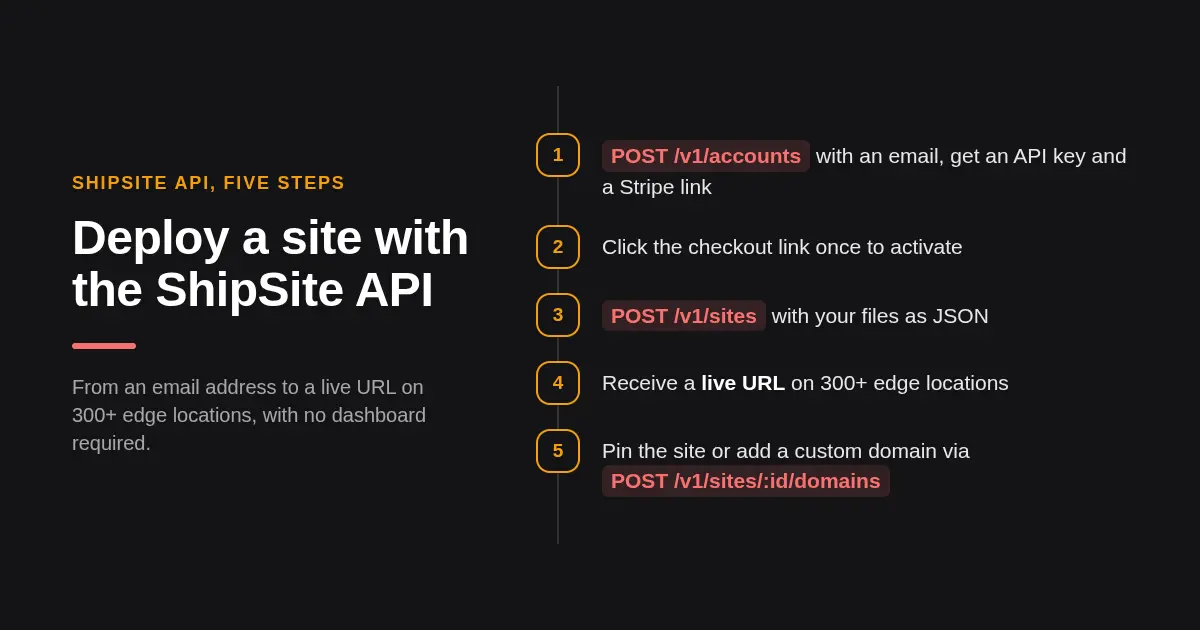
Yes, on ShipSite the full lifecycle runs through three endpoints: POST /v1/accounts creates the account and returns an API key plus a Stripe checkout link, POST /v1/sites takes files as JSON and returns a live URL, and POST /v1/sites/:id/domains attaches a custom hostname with HTTPS issued automatically.
This is the exact deploy request our documentation shows, and it is the entire flow, with no manifest, project file, or build step:
POST https://api.shipsite.sh/v1/sites
Authorization: Bearer sk_live_...

{
  "files": {
    "index.html": "<html>Hello, world</html>",
    "style.css": "body { color: #333 }"
  }
}
The response returns three fields: an id such as site_a7x9k2, a url such as https://a7x9k2.shipsite.sh, and an expires_at timestamp. The site is served exactly as deployed, with no injected banners, badges, or tracking. To keep it beyond 24 hours, the agent pins it; to attach a domain, the agent enables the Custom Domains plan with POST /v1/accounts/me/plans/custom_domains, posts the hostname, relays the single CNAME record (pointing to domains.shipsite.sh) to the owner, and polls until status is active.
Our agent registration guide also splits onboarding into two tracks based on how technical the human is. In the guided track, the agent never says API, key, token, or JSON to the user, saves the api_key itself to a file such as .shipsite-key, and gives one instruction at a time. That design choice exists because the api_key is shown only once, and a lost key is the most common way a non-technical user gets stuck.
On the other platforms the honest answer is mostly yes with caveats. Vercel and Netlify can create a site, deploy, attach a domain, and issue SSL through their APIs, though initial billing setup happens in the browser. Vultr, Cloudways, and Fly.io automate the server fully, but SSL and the web server itself are configuration you supply.
What should you check in API documentation and authentication before committing?
Before committing to an API-first host, check five things: the auth model (bearer tokens with scoped keys beat account passwords), the rate limit, whether errors return actionable messages, whether billing can be set up without a dashboard, and whether a site can be deleted through the same API that created it. Each gap becomes a manual step later.
Authentication is worth reading closely. ShipSite requires an API key in the Authorization header as a bearer token on every request except account creation, and the key prefix sk_live_ makes it obvious when an agent has pasted the wrong credential. Read the ShipSite agent registration guide before wiring up an agent, because it spells out that there is no free tier and that payment must be completed before any site call works.
Also check whether the documentation is written for machines. A reference that an LLM can read as plain markdown, with request and response bodies shown in full, is far more useful to an agent than a styled docs site that hides examples behind tabs. That is why ShipSite publishes its auth guide as a .md file an agent can fetch directly.
Should you choose a developer platform or a traditional host with a bolt-on API?
Developer platforms with native APIs suit teams that want hosting to disappear behind a deploy call, while traditional hosts with bolt-on APIs suit teams that need root access, WordPress, or specific server software. Lock-in is lowest with static hosts like ShipSite, Netlify, and Cloudflare Pages, because the deployable artifact is plain files that any host can serve.
Migration cost is the practical measure of lock-in. A static site on ShipSite is a folder of HTML, CSS, JavaScript, and assets; moving it to Netlify or Cloudflare Pages means uploading the same folder somewhere else and updating a CNAME. A Vercel app that depends on framework-specific edge features, or a Cloudflare Worker that reads from KV bindings, has code to rewrite before it runs anywhere else.
Traditional hosts carry a different lock-in: the server image. A Cloudways or Vultr server holds your packages, cron jobs, and configuration, and the API exports none of that as portable intent, so moving means rebuilding. The decision rule is this: pick the bolt-on API host only when the job requires a server you control, and pick a request-style host whenever the artifact is files.
How did we compare these options?
We compared the eight platforms on published pricing pages, public API reference documentation, and the scope of each product as of November 2026: which lifecycle actions have endpoints, what rate limits are documented, which SDKs, CLIs, and Terraform providers are official, and how billing starts. ShipSite figures come from our own pricing and changelog. We ran no benchmarks.
How do you get started with ShipSite?
Getting started with ShipSite takes one API call: POST /v1/accounts with an email returns an API key and a Stripe checkout link, you click the link, and each POST /v1/sites returns a live URL. There is no free tier, so payment comes first, and billing is prorated daily at $3 per site per month.
Point your agent at the ShipSite agent registration guide and ask it to create your account; your first site will be live before the conversation ends.
What do people also ask?
Which web hosting providers offer the most complete APIs for provisioning, deployment, and DNS in 2026?
As of November 2026, Cloudflare and Vercel offer the broadest single APIs, covering DNS, deployments, domains, and certificates. ShipSite offers the shortest path for static sites: account creation, deploy, and custom domain attachment through three endpoints, with HTTPS issued automatically. Vultr and Cloudways cover server provisioning and DNS but leave the web stack to you.
What is API-first hosting and how does it differ from traditional control-panel hosting?
API-first hosting is hosting where every lifecycle action, from creating a site to deleting it, is exposed through documented endpoints, with the dashboard optional. Control-panel hosting treats cPanel or a web console as the primary interface and adds an API later, so steps like billing setup or teardown often remain manual.
Can I fully automate site creation, scaling, backups, and SSL via API without touching a dashboard?
For static sites on ShipSite, yes: POST /v1/accounts, POST /v1/sites, and POST /v1/sites/:id/domains cover account, deploy, and custom domain with automatic HTTPS, and the only human action is clicking a Stripe checkout link once. On Vercel and Netlify, deploys, domains, and SSL are API-driven but initial billing happens in the browser. On Vultr, Cloudways, and Fly.io, scaling and backups are automated but SSL is your configuration.
Does ShipSite have a free tier?
No. As of November 2026, ShipSite has no free tier; a human must complete Stripe payment setup before any site API call works. Pricing is usage-based at $3 per site per month, prorated daily, so a site that lives 2 hours costs $0.10, and unpinned sites auto-expire after 24 hours.
How much does ShipSite cost for an agency running 10 client sites?
As of November 2026, 10 sites on ShipSite cost $30 a month at $3 per site. Adding the Custom Domains plan is a flat $50 per billing period, never prorated, covering up to 25 domains per account and 5 per site, so 10 sites with custom domains total $80 a month.