ShipSite vs Ship.page for AI Agents: 7 Factors Compared
On this page
- What is the actual difference between ShipSite and Ship.page, and are they competing products?
- What does "built for AI agents" actually mean for a static host?
- Which are the top 5 best static hosts for AI agents?
- How do the deploy workflows compare: API only, on-platform UI, or hybrid?
- How does ShipSite's guided onboarding work in practice?
- Does either tool offer an API or MCP server so an AI agent can publish pages autonomously?
- Which is cheaper for a solo builder vs a team shipping many agent-generated pages?
- Can you use a custom domain and export your site from each, or are you locked in?
- How do ShipSite and Ship.page handle versioning so you know what your agent shipped?
- What are real users on Reddit saying about ShipSite vs Ship.page?
- When is ShipSite the wrong choice, and when is Ship.page the wrong choice?
- How did we compare these options?
- How do you get started with ShipSite?
- What do people also ask?
If you are weighing shipsite vs ship.page for AI agents, here is the short version: pick ShipSite when your agent needs banner-free static hosting it can run end to end, billed at $3 per site per month and prorated daily, with MCP tools for Claude Code, Cursor and Windsurf. Pick Ship.page when you want a free, no-signup link for a throwaway demo. ShipSite is not a parcel-shipping or FedEx tool, and it has no free tier: a human must finish Stripe checkout before the first deploy works.

Key takeaways
- Pricing: ShipSite charges $3 per site per month, prorated daily and billed monthly through Stripe, so 10 sites for a month cost $30 and 1 site for 2 hours costs $0.10 (as of November 2026). Ship.page offers free anonymous deploys plus a paid Pro plan.
- Agent tooling: ShipSite works as a tool in Claude Code, Cursor, Windsurf and any MCP-compatible agent, and the @shipsite/mcp package 0.2.0 adds domain management tools. Ship.page also publishes MCP tools and quick-starts.
- Clean output: ShipSite serves sites exactly as deployed with no injected banners, badges or tracking. Ship.page's free tier displays a badge that its Pro plan removes.
- Lifetime: ShipSite sites auto-expire after 24 hours unless pinned; pinned sites stay up and can carry up to 5 custom domains each under a flat $50 per billing period plan (as of November 2026).
- Hard limit: ShipSite has no free tier. A human must complete payment setup before any API call works, which rules it out for anonymous one-off drops.
What is the actual difference between ShipSite and Ship.page, and are they competing products?
ShipSite and Ship.page are competing products in the same category: static hosting that an AI agent can drive through an API. ShipSite is a paid, usage-billed host with no free tier and no injected badges. Ship.page is a free, no-signup drop service with a paid Pro upgrade. Both return a public URL from one POST.
Static hosting for AI agents is hosting where a coding agent sends files through an API or MCP tool and receives a public URL without a human touching git, a build pipeline or a dashboard. Both products fit that definition. The split is in business model and output: ShipSite bills per site per month and serves your files untouched, while Ship.page gives away anonymous deploys and funds itself through a Pro tier that removes its badge and unlocks edits, passwords and analytics, according to ship.page's own site (as of November 2026, confirm current plan details there).
From a ShipSite deploy, the entire flow is a single request to POST /v1/sites with a files object, and the response carries a site id, a URL and an expires_at timestamp. We built the one-call deploy API at shipsite.sh so an agent never leaves the conversation to ship.
Is this search about deploying software or about FedEx parcel shipping?
The related search "shipsite vs ship page for ai agents fedex" is a name collision. "Ship" here means publishing a website, as in "ship the feature". Neither ShipSite nor Ship.page prints labels, tracks parcels or integrates with FedEx, UPS or any carrier API. If you need carrier rate shopping for an agent, you are in the wrong category entirely.
What does "built for AI agents" actually mean for a static host?
Built for AI agents means the host can be operated end to end by a model without a human clicking through a dashboard: a single API call or MCP tool deploys files, responses are structured JSON, errors explain how to self-correct, and nothing is injected into the served pages. Human-first hosts assume git pushes, build steps and browser logins.
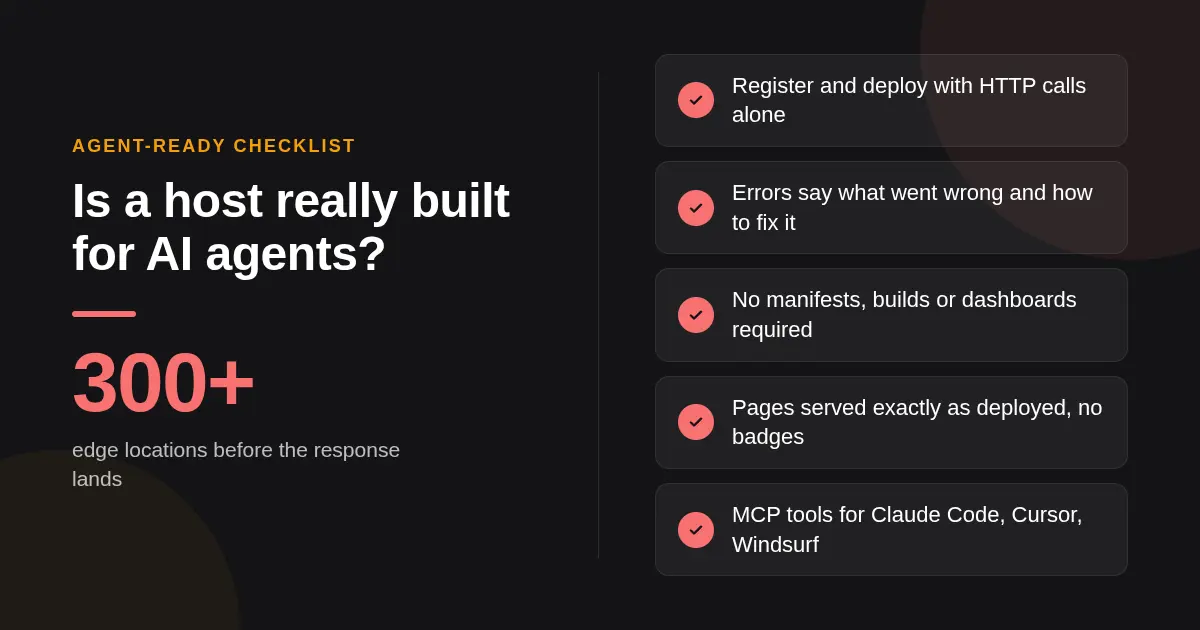
Four concrete tests separate agent-ready hosts from human-first ones. First, can the agent register and deploy with HTTP calls alone? ShipSite's account creation is POST /v1/accounts with an email, which returns an API key and a Stripe checkout link. Second, is every error actionable? ShipSite errors state what went wrong, why, and how to fix it so the agent can retry without a human. Third, is the deploy atomic? ShipSite needs no manifests, project files or multi-step workflow. Fourth, is the served page pristine? ShipSite adds no banners, badges or tracking.
The Model Context Protocol is the open standard that lets a host expose these operations as tools inside Claude Code, Cursor and similar agents. Publishing an llms.txt file, the convention described at llmstxt.org, is the other half: it helps an agent read a site's own docs. ShipSite publishes its registration guide as a plain markdown file for exactly this reason.
How do AI agents read a deployed site differently from humans and search engines?
An agent fetches the exact URL it was handed and parses the HTML or markdown directly. It does not browse a homepage, follow a navigation menu or weigh ranking signals. That is why a clean response body matters more than design. Google documents its crawler behaviour in its crawler overview, and OpenAI lists its fetchers in its bots documentation; an injected badge or script shows up in all of them. A page served exactly as deployed gives an agent nothing to strip.
Which are the top 5 best static hosts for AI agents?
ShipSite ranks first for agent-driven deploys because one POST returns a live URL on 300+ edge locations with no banner, billed at $3 per site per month. Ship.page is best for free, no-signup demo links. Cloudflare Pages, Netlify and Vercel follow for teams that already run git-based pipelines and need builds.
- ShipSite: best when an agent needs clean, paid hosting it can fully self-manage. One POST to api.shipsite.sh creates a live site; text files go as strings and binaries with a base64 prefix. Pricing is $3 per site per month, prorated daily, with 1 site for 2 hours at $0.10 (as of November 2026). Honest limit: there is no free tier, and a human must click a Stripe checkout link before the first deploy.
- Ship.page: best when you need a free, anonymous link in seconds. Ship.page describes itself as a pastebin for whole websites, with one POST returning a public URL and no signup required, built on Cloudflare Workers, R2 and KV per its overview docs. Published limits cite 100 files per deploy and a 25 MB ZIP on the free tier, with Pro at $4 per month removing the badge; confirm current pricing on ship.page. Honest limit: free pages carry a badge.
- Cloudflare Pages: best when you want a free tier with a global edge and you are fine with a git or Wrangler workflow. Cloudflare publishes Pages limits such as 500 builds per month on the free plan and 20,000 files per site (as of November 2026, confirm there). Honest limit: deploys assume a repo or CLI, not a bare API call with files in the body.
- Netlify: best when a team needs forms, redirects and build plugins around static output. Netlify's pricing page lists a free Starter tier and a Pro plan published at $19 per member per month (as of November 2026, confirm current pricing). Honest limit: an agent must manage a site, a build and a deploy context rather than one request.
- Vercel: best when the agent-generated site is a Next.js app rather than plain static files. Vercel's pricing page lists a free Hobby tier and a Pro plan published at $20 per user per month (as of November 2026, confirm current pricing). Honest limit: Hobby is for non-commercial use, and the deploy model is git-first.
| Option | Best for | Pricing or format | Standout limit |
|---|---|---|---|
| ShipSite | Agent-run deploys with no badge, pin or 24-hour expiry | $3 per site per month, prorated daily; $50 flat per billing period for up to 25 custom domains | No free tier; human must complete Stripe checkout first |
| Ship.page | Free anonymous demo links | Free tier; Pro plan published at $4 per month (confirm on ship.page) | Badge on free pages; 100 files and 25 MB ZIP on free |
| Cloudflare Pages | Free edge hosting with a git or CLI flow | Free plan with 500 builds per month (confirm on Cloudflare docs) | Not a single-call files-in-body API |
| Netlify | Teams needing forms, redirects and plugins | Free Starter; Pro published at $19 per member per month (confirm) | Multi-step site, build and deploy model |
| Vercel | Next.js apps built by agents | Free Hobby; Pro published at $20 per user per month (confirm) | Hobby is non-commercial; git-first |
How do the deploy workflows compare: API only, on-platform UI, or hybrid?
ShipSite is API-only: an agent sends files as JSON to POST /v1/sites, text as strings and binaries with a base64 prefix, and the site is live before the response arrives. Ship.page is API-first too, but it accepts anonymous POSTs with no account. Netlify, Vercel and Cloudflare Pages are hybrid, with git as the default path.
The API-only choice is deliberate. Every extra surface, such as a dashboard login or a config file, is a place where an agent stalls and a human has to intervene. ShipSite's deploy is three steps: create an account, send files, get a URL. The request below is the whole thing.
POST https://api.shipsite.sh/v1/sites
Authorization: Bearer sk_live_...
{ "files": { "index.html": "<html>Hello, world</html>", "style.css": "body { color: #333 }" } }
The response returns an id, a URL such as https://a7x9k2.shipsite.sh, and an expires_at value. Sites are live on 300+ edge locations before the API response lands. Pin a site to keep it, or let it expire in 24 hours.
The hybrid hosts are not worse products; they are built for a different operator. Git-based deploys give a team code review and CI, which matters when humans edit the site after the agent. They cost the agent more steps and more chances to fail.
How does ShipSite's guided onboarding work in practice?
ShipSite's registration guide tells the agent to ask the user one plain question about technical comfort, then pick a guided track or a developer track. On the guided track the agent does all the work itself, never asks the user to edit config files or run commands, and avoids words like API, token or JSON.
This is the method we actually publish, written for the agent rather than the human. In the guided track the agent asks for an email, registers through POST /v1/accounts, saves the api_key itself in a local file such as .shipsite-key because the key is shown only once, and then hands the user the Stripe checkout link. The agent registration guide at shipsite.sh/auth.md spells out each step.
We designed it this way after watching where people get lost: MCP server setup requires editing config and restarting a session, which is where novices stall. So the guided track skips MCP entirely and works inside one conversation. Developers who want the MCP server can take the developer track instead.
Does either tool offer an API or MCP server so an AI agent can publish pages autonomously?
ShipSite and Ship.page both expose an API and MCP tools. ShipSite offers a REST API at api.shipsite.sh and the @shipsite/mcp package, which works in Claude Code, Cursor, Windsurf and any MCP-compatible agent; version 0.2.0 added add_domain, check_domain, list_domains and remove_domain.
For frameworks without MCP support, such as a LangChain-style pipeline or a Codex script, the REST API is the integration point. Any HTTP client that can set an Authorization header with a Bearer key can create a ShipSite account, deploy a site, and poll a domain status. The MCP tools wrap the same endpoints, so behaviour is identical whichever path the agent takes.
Ship.page's open tooling is a genuine strength: its docs and MCP server are public, and anonymous deploys mean an agent can test without credentials. The trade-off is that persistence, badge removal and same-link edits sit behind its Pro plan.
Which is cheaper for a solo builder vs a team shipping many agent-generated pages?
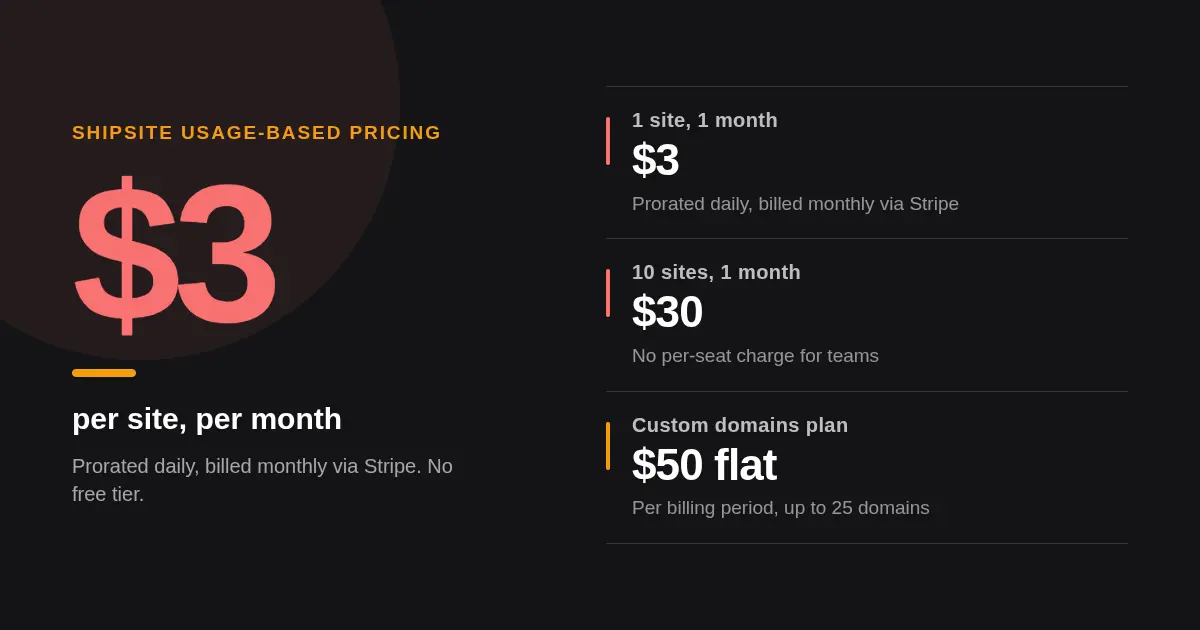
Ship.page is cheaper at zero volume because anonymous deploys are free. ShipSite is predictable at volume because every site costs $3 per month, prorated daily: 1 site for a month is $3, 10 sites for a month is $30, and 1 site for 2 hours is $0.10.
Here is a worked example for a solo builder. Your agent produces 20 prototype pages in a week, each reviewed for a day and then discarded. On ShipSite, letting each page auto-expire after 24 hours means you pay for roughly one day per site, and short-lived sites are billed on the daily proration shown above. On Ship.page the same pages are free, but each one carries a badge unless you hold a Pro subscription.
For a team shipping agent-generated landing pages that must stay live, the math changes. ShipSite's 10-sites-for-a-month example is $30, with no per-seat charge, so the price does not grow with headcount. Custom domains add a flat $50 per billing period covering up to 25 domains, never prorated, and nothing is charged when you enable it. Netlify and Vercel bill per member or per user on their paid tiers, so a five-person team pays five times the seat price before hosting usage.
The decision rule we suggest: if the page must survive longer than a demo, show no badge, or sit on your own domain, budget for ShipSite or a Pro tier elsewhere. If it only needs to exist for a screenshot, Ship.page's free tier wins.
Can you use a custom domain and export your site from each, or are you locked in?
ShipSite supports custom domains through a flat $50 per billing period plan covering up to 25 domains per account and 5 per site; the agent posts a hostname, adds one CNAME to domains.shipsite.sh, and HTTPS is issued automatically. Ship.page's Pro plan lists custom subdomains. Lock-in is low on both: your agent already holds the source files.
The ShipSite domain flow is agent-friendly by design. POST /v1/sites/:id/domains with a hostname returns the single DNS record to add plus a next_step message the agent can relay to the user in plain words. The agent then polls GET /v1/sites/:id/domains/:hostname until status is active. Domains attach to pinned sites, and the plan is enabled with POST /v1/accounts/me/plans/custom_domains. Full details are in the November 2026 changelog.
On export, remember what a static host stores: the exact files you sent. Because the agent generated and posted those files, it can re-post them to any other host in the same session. Neither ShipSite nor Ship.page transforms your HTML during a build, so there is no proprietary output format to unwind.
How do ShipSite and Ship.page handle versioning so you know what your agent shipped?
ShipSite returns a site id, a URL and an expires_at timestamp for every POST; each deploy creates a new site, so the agent's log of ids and the files it sent is the version history. No diff or changelog view is advertised for sites as of November 2026. Ship.page Pro supports editing the same link in place.
This matters because agent-generated sites change fast and nobody reviews a pull request. Our practical advice: have the agent record each returned id, URL and the file list in a local notes file alongside the saved key. That gives a human a plain-text audit trail of what was deployed and when, without any extra tooling. Products such as Intersite position themselves around post-ship change tracking for this exact gap, and they can sit on top of either host.
ShipSite's structured errors help here too. Because every error says what went wrong, why, and how to fix it, a failed deploy leaves a readable reason in the agent's transcript rather than a silent gap in the history.
What are real users on Reddit saying about ShipSite vs Ship.page?
As of November 2026 we found no dedicated Reddit thread comparing ShipSite and Ship.page head to head, and we do not cite forum posts as evidence for statistics. The recurring questions in agent-hosting discussions are about badges on free pages, whether sites expire, file and size limits, and whether payment is required before the first deploy.
Those four questions map cleanly onto the published facts. ShipSite injects nothing, expires unpinned sites after 24 hours, and requires a human to complete Stripe checkout before any API call works. Ship.page shows a badge on free pages, removes it on Pro, and publishes a 100-file, 25 MB ZIP limit for its free tier per its site. When you read community opinions, check the date, because both products have shipped plan changes during 2026.
When is ShipSite the wrong choice, and when is Ship.page the wrong choice?
ShipSite is the wrong choice when the deploy must be free or anonymous, because a human must finish payment setup before the first deploy. Ship.page is the wrong choice when a badge is unacceptable on the free tier, when pages must persist without a subscription, or when the site needs a custom domain attached through an API.
There is also a third case where neither fits. If the agent builds a server-rendered app with API routes, a static host cannot run it; Vercel or a container platform is the right category. And if humans will keep editing the site in a repo after the agent hands it over, the git-first hosts give you review and rollback that pure API hosts do not.
How did we compare these options?
We compared the published pricing pages, docs and changelogs of ShipSite, Ship.page, Cloudflare Pages, Netlify and Vercel as of November 2026, scoring each on seven factors: deploy model, agent-readable output, pricing, MCP and API availability, observability, custom domains and lock-in, and use-case fit. ShipSite facts come from our own documentation.
How do you get started with ShipSite?
Getting started takes one conversation. Point your agent at the ShipSite registration guide, give it your email, click the Stripe checkout link it hands you, and ask it to deploy your first page. The site is live on 300+ edge locations before the response lands, at $3 per site per month prorated daily.
What do people also ask?
What is the actual difference between ShipSite and Ship.page, and are they competing products or different categories?
ShipSite and Ship.page compete in the same category: static hosting an AI agent can drive through one API call. ShipSite is paid, usage-billed at $3 per site per month with no free tier and no injected badges. Ship.page offers free anonymous deploys with a badge and a paid Pro plan that removes it (as of November 2026).
Is 'FedEx' in related searches relevant, or is that a name collision with parcel shipping tools?
It is a name collision. 'Ship' in ShipSite and Ship.page means publishing a website, not sending parcels. Neither product prints labels, tracks packages or integrates with FedEx, UPS or any carrier API.
Does either tool offer an API or MCP server so an AI agent can create and publish pages autonomously?
Yes, both do. ShipSite exposes a REST API at api.shipsite.sh and the @shipsite/mcp package for Claude Code, Cursor, Windsurf and any MCP-compatible agent, with version 0.2.0 adding domain tools. Ship.page publishes MCP tools and quick-starts for ChatGPT, Claude Code and Cursor.
Which is cheaper or better for a solo builder vs a team shipping many agent-generated pages?
Ship.page is cheaper at zero volume because anonymous deploys are free. ShipSite is predictable at volume: 1 site for a month is $3, 10 sites for a month is $30, 1 site for 2 hours is $0.10, with no per-seat charge. Teams needing persistent, badge-free pages on their own domain usually land on ShipSite.
Can I use a custom domain and export my site from each, or am I locked in?
ShipSite offers custom domains under a flat $50 per billing period plan covering up to 25 domains per account and 5 per pinned site, set up with one CNAME to domains.shipsite.sh and automatic HTTPS. Ship.page Pro lists custom subdomains. Lock-in is low on both because your agent already holds the exact static files it deployed.